Initial Situation
The Trinity Academy in Boma N’gombe is a private pre-school and primary school with 240 pupils. 25% of these are orphans who are supported by a special support programme run by the school together with international partners and attend the school’s boarding school. Technik ohne Grenzen e.V. has been in contact with the school for several years, including a tree planting campaign and the construction of a new building for the sustainable operation of the kindergarten in several project phases. Trinity is endeavouring to operate sustainably overall; for example, there is a school farm that provides food for the school, the first small solar panels and approaches to using rainwater. TeoG is currently supporting these approaches in projects on agroforestry, rainwater harvesting and biogas utilisation. This project is a further building block in the sustainable management of the school and the associated boarding school.
Challenge
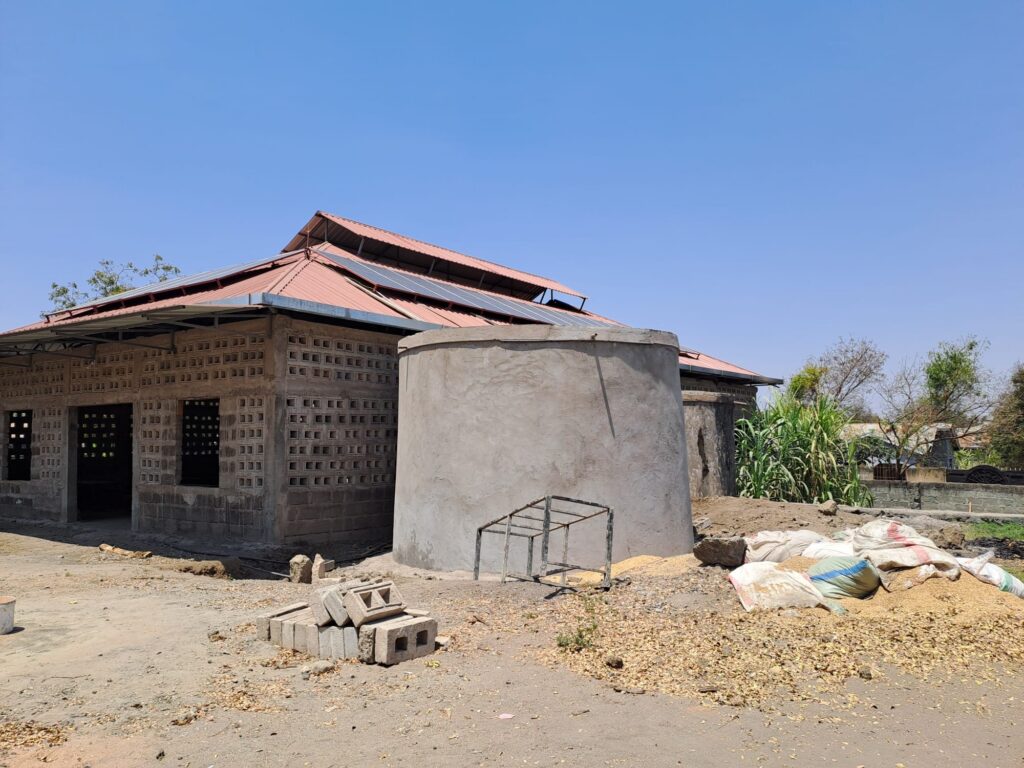
Breakfast and a warm lunch are to be provided for the primary school and kindergarten children. In front of the school kitchen, there is a dining area foreseen for the kids to eat. Currently, this area has walls, but no roof, leaving the kids exposed to rain or plain sun during lunch time. Many kids rather seek for shelter in the shade of nearby trees, eating on the ground or standing. Also, the local authorities have been pointing out the the roof is needed in terms of protection. At the same time, the school faces an increasing demand of electricity for a planned new workshop, the dormitories, the teacher’s accommodation and potentially the kitchen, where the use of fire wood for cooking shall be reduced. Another aspect is that there is already a rainwater tank next to the kitchen, which is not used efficiently due to a lack of roofing area for rainwater harvesting.
Solution
The aim of this project is to construct a roof for the dining area with integrated solar panels, or consisting of solar panles, which is also used for rainwater collection. The solar power which is gained shall be used in the dormitories, the teachers accommodation and in future also the schools workshop. One does also have to think about new ways of using electricty in the kitchen to reduce the amount of firewood needed, which will help the environment and improve working conditions for kitchen staff. This goes hand in hand with our project on the use of biogas to support an integrated, sustainable apporach. The rainwater will be used to feed the biogas system and to water the school garden.
Results
We could implement this project in September 2025. A new roof for the dining hall of the school was constructed which is covered by 20 solar panels, leading to an installed solar power of 10 kW. The construction of the roof and the light weight walls, which allow an optimum ventilation, was done by local craftsmen under the supervision of Mr. Ndossi, the director of Trinity Academy. The roof also allows rainwater capture to reduce the amount of public groundwater or salty well water tob e used at the school. The dining hall was equipped with new tables and benches that allow all kids to sit down and have lunch together. The ceiling of the kitchen storage room was also renovated to give space for the electricial equipment, like inverter and batteries. In September, our German TeoG Team came to Tanzania to help with the installation of the solar system. The panels are installed on three sites of the roof and feed power into a 10 kWh battery. The electricity supplies the dormitories for the 60 boarding students, the classrooms, the outer lights, the water pump of the well, the administration office and the kitchen itself, where we also installed a new electrical stove. This stove is used for hot water and tea and decreases the amount of firewood used in the kitchen. At this point, we did not connect the workshop of the school, because some of the older electrical tools, like the welding machine, might damage the system due to high peak demands. Also, we found out that we should double up the battery capacity in the near future, since the electricity use during the night is higher than expected. This means that still a bit of electricity needs to be provided by the local electricity grid, which fails regularly. Another follow up project could be the extension of the electical stoves in the kitchen to further limit smoke and dust caused by the wood-fired stoves, which goes hand in hand with the construction of a biogas system at Trinity Academy. Overall, we can say that the project was implemented very sucessfully, providing sustainable electricity for more than 200 kids at the school. We thank the entire team, sponsors and supporters that made this great project possible and hope to continue our work with Trinity in the upcoming years.
Sustainable Development Goals
This project is supported by